


Part One traced how a household cloth became a legally protected global name. Part Two explores Harris Tweed today.
Harris Tweed is safeguarded by an Act of Parliament. It has remained, against all commercial logic, a product still made on domestic looms in weavers' own homes. Part Two picks up that thread in the present day, following the cloth from an unexpected order from Nike in 2004 through fashion runways, film and television, to its current status as a sought-after material across the globe.
At the end there’s a guide for anyone who wants to see the weaving process firsthand, visit the mills and museums of Lewis and Harris, or bring home a piece of genuine Harris Tweed, Orb stamp included.
21st Century changes
Machine-spinning and vat-dyeing have now replaced the older handmade methods of preparation, but every metre is still woven on a domestic loom, in someone’s home, in the Outer Hebrides. In an era of fast fashion and synthetic materials, that continuity has allowed space for Harris Tweed to continually reinvent itself.
The unexpected call from Nike
In 2004, global sportswear giant Nike bypassed the usual industry channels and emailed Donald John Mackay directly. The big brand requested the local weaver on the Isle of Lewis produce 10,000 metres of cloth for a new trainer line. Mackay called Derick Murray at Shawbost Mill. Murray called every weaver he knew. Within weeks, more than 50 island weavers were working to fulfil this single order for Nike. Harris Tweed made the news and became fashionable again.
In 2012, when Alexander McQueen featured Harris Tweed in his winter collection, it sparked a revival of the cloth. Vans and Clarks worked it into footwear with herringbone and houndstooth on trainers and re-styled originals. Vivienne Westwood, who had used the cloth in 1987, returned to it for fresh inspiration. Sofa brand Tetrad introduced a Harris Tweed furniture range. All of this happened in the same year. The global fashion industry had decided, almost simultaneously, that a hand-woven cloth from the Outer Hebrides was to be coveted. The surge in demand was significant enough to bring a new generation of skilled weavers into the trade.
Pop culture ambassadors
Actor Matt Smith wore it as Doctor Who in 2010. Peaky Blinders gave tweed a brooding, dangerous edge in 2013 that has proved remarkably durable. Maria Grazia Chiuri used it for Dior in 2024. Nike returned in 2025 with a limited-edition Dunk Low, again with Shawbost Mill, the Orb trademark woven in as a design feature. Adidas followed in 2026 with the Handball Spezial.
Then there was The Traitors, filmed in a Scottish castle: Hebridean-born contestant Stephen Libby wore clothes made from a roll of Harris Tweed woven by his great uncle. Host Claudia Winkleman wore Harris Tweed throughout the series.
Ralph Lauren and Paul Smith return to it season after season. Japan and South Korea have become significant markets. The Outer Hebrides now holds World Craft Region status. Around 8,000 patterns exist, many inspired by the landscape and light of the islands, and every metre can be traced back to the weaver who made it.
This cluster of islands off the north-west coast of Scotland weaves a cloth that has adorned the feet of Nike customers in Tokyo, the ateliers of Dior and on TV's popular characters. The cloth remains local and the world keeps coming to it.
Finding Harris Tweed in Scotland: a guide for the curious traveller
The best way to appreciate Harris Tweed is to see it being made. The Outer Hebrides is the only place where the genuine cloth is produced.
Visit a working mill
There are three independently-owned mills in the Outer Hebrides, all on Lewis and each with its own character. All three dye, blend and spin the wool before sending it out to self-employed weavers with the pattern. The finished cloth comes back to be washed, dried, cut, inspected and stamped with the Orb trademark before being delivered to order.
Of the three mills on the islands, only one can be toured. Carloway Mill at Garenin, Lewis, offers guided tours and working demonstrations from wool to finished cloth. It is the oldest of the three remaining mills and a non-profit organisation whose machinery dates as far back as 1892. Carloway employs a multi-talented workforce whose artisan skills allow it to operate using traditional craft machinery that visitors can see in action. Tours run Monday to Thursday at 10.30am and 2pm, by email appointment. The shop sells cloth by the metre as well as finished garments and accessories. It’s cash only, so come prepared.
Although Harris Tweed Hebrides at Shawbost Mill and Kenneth Mackenzie Ltd don't offer tours, both sell cloth and products directly.
Gearrannan Blackhouse Village
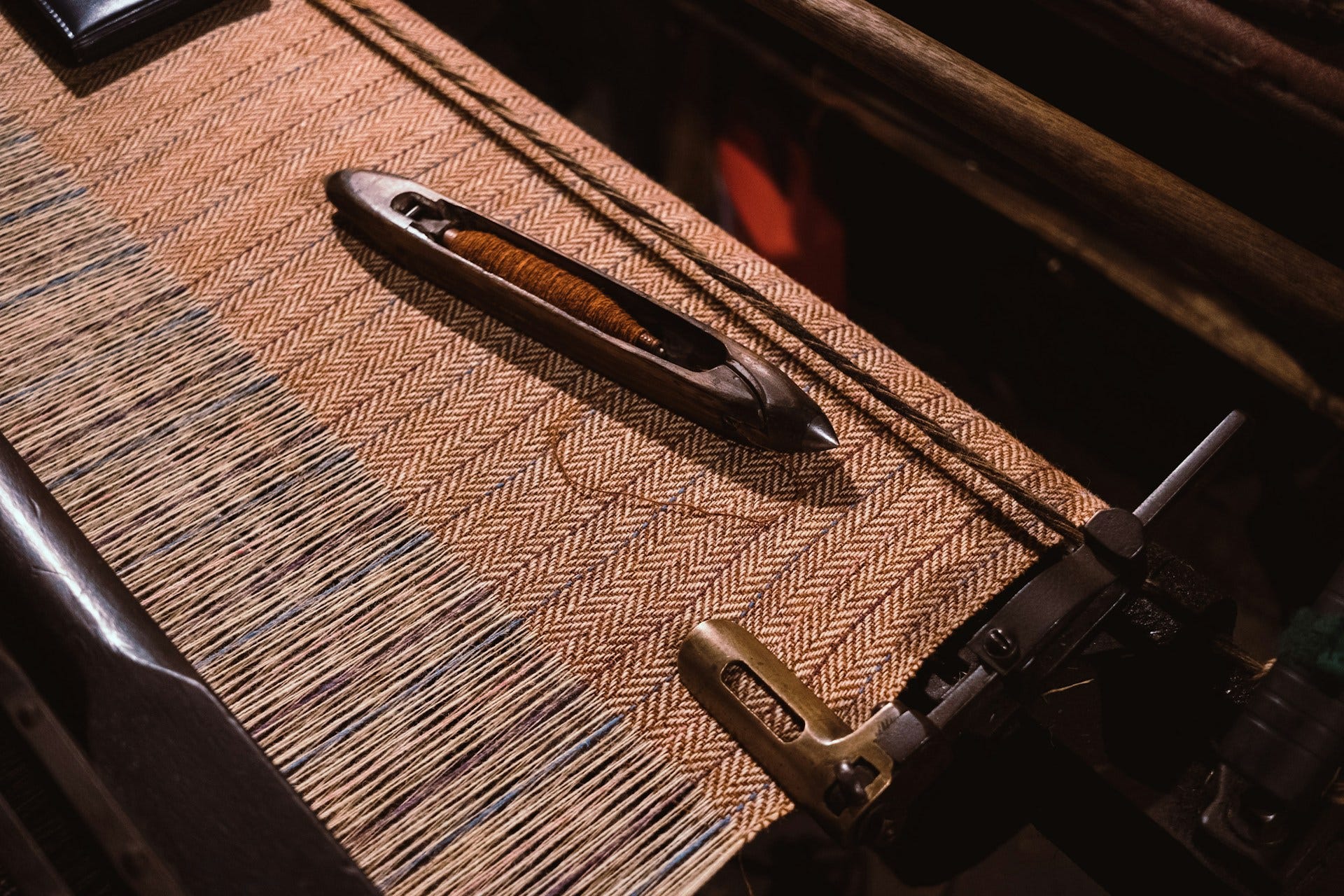
Just a short drive from Carloway Mill, and well worth combining into a single half-day on the west coast of Lewis, is Gearrannan Blackhouse Village. The village features a number of restored blackhouses (traditional thatched stone-walled dwellings) and one of them houses a fine example of a traditional human-powered loom that is still used to this day to transform wool into Harris Tweed. Weaving was once an essential winter occupation for Hebridean families.
There is also a café serving home-made food, a gift shop, and scenic coastal walks. The Visitor Centre, Museum, Café and Shop are open from 30th March until the end of October. There is also self-catering accommodation available in the restored blackhouses themselves. It’s one of the more extraordinary and coveted places to spend a night in Scotland.
Follow the Harris Tweed Trail
The Harris Tweed Trail maps out exhibitions, shops, museums and individual weavers across Lewis and Harris, some of whom sell direct from their homes. It's the most rewarding way to immerse yourself.
Visit a weaver at home
The Harris Tweed Trail will point you towards individual weavers, and this is well worth doing. Driving through villages like Shawbost, you'll notice sheds in the gardens of many houses. These are the weavers' workshops, and some weavers welcome visitors and will talk about their work. Independent certified weavers can work either for a mill or for themselves, but all have their finished cloth returned to a mill to be inspected and stamped by the Harris Tweed Authority — so quality control is maintained at every stage. Some sell cloth directly from their homes. It is the most personal way to encounter the industry, and the most memorable.
The Orb trademark stamped on every length of genuine Harris Tweed is one of the oldest trademarks in the world still in use today. That stamp of quality, on a bolt of cloth woven at a kitchen loom in the Outer Hebrides, connects the weaver's work to something much larger.
Museums
The Harris Tweed Story Room sits on the first floor of the Town Hall on Cromwell Street in Stornoway. Run by the Harris Tweed Authority, it tells the full story of the cloth, from its origins on the croft to its appearances on the Paris catwalk. Tours begin with a short film, then take visitors through the industrial history and development of the industry, with a live weaving demonstration and the chance to try the loom yourself. Tours run on the hour, every hour, Monday to Friday from 10am, with the last session at 2pm (£12).
Museum Nan Eilean, on the grounds of Lews Castle in Stornoway, holds Harris Tweed-related archives and artefacts as part of its wider collection of Hebridean history. Entry is by donation (£5 suggested)
Where to shop
Look for the Orb label or stamp, a mark of genuine Harris Tweed. Keep in mind that the trademark refers to the quality and origin of the cloth itself and not the entire product it features in. Shop with discernment, and to suit your own budget.
On the islands, the Harris Tweed shop in Tarbert (Harris) sells cloth by the metre alongside clothing and accessories. Harris Tweed Hebrides has a retail store in Stornoway, and the Borrisdale Tweed Retail Outlet (Leverburgh) stocks exclusive homewares and accessories (Monday to Friday, 12pm–6pm).
Buying cloth directly from individual weavers along the trail is deeply satisfying. Some sell online as well as in person.
Edinburgh
On the mainland, Walker Slater sells a quality range of Harris Tweed clothing in its Edinburgh and Glasgow shops. Kiltane also stocks a range of quality Harris Tweed products.
For those who can't make it to the isles but want more than a shop purchase, Islander runs bag-making workshops in Edinburgh and St Andrews. In around an hour, you choose your cloth and bag components, construct the bag with guidance and leave with your own custom Harris Tweed bag. It is a popular activity. If you can’t make your own, you can also buy readymade islander bags and also at Edinburgh Woollen Mill
To buy Harris Tweed cloth by the metre, go to Edinburgh Fabrics (12-14 St Patrick Square) or Stewart Christie (61-63 Queen Street) which is also Scotland’s oldest bespoke tailor, dating back to at least 1720.
Read Part One of the Harris Tweed story:
Harris Tweed: the cloth protected by law (and still made at home in the Outer Hebrides)

Part One traces how a household cloth became a legally protected global name; Part Two will explore Harris Tweed today.